Fear and emotion strengthen the reliving field
Handling the UndeadFear and emotion strengthen the reliving field, making feeling more than a response to the returned dead: it becomes part of the force binding and endangering the living and the dead alike. The novel presents the field as reciprocal. The dead affect the minds of the living, but the living’s emotions feed back into the dead, so terror can magnify the very presence that inspires it.
How the Field Is Experienced
When Flora approaches the buildings at The Heath, the field grows stronger with every step. Beyond the gates it had felt like streams running through her head; among the buildings it thickens into something like fog, allowing her to hear separate thoughts as faint, distant cries. Yet the field is not simply a crowd of distinct minds. Flora senses many consciousnesses as a powerful presence that is there without thinking any particular thought. Individual expressions of horror break through that presence, and their emotional force intensifies it.
The experience is bodily and difficult to contain. Flora feels that there is not enough room for her, as though a miniature version of everything happening in the area has been compressed inside her head. Terror and despair dominate, and the intensity seems so material that she imagines the field might be visible, billowing like heat above asphalt. Her warning that the situation is dangerous arises from being caught inside this emotional pressure, not from observing it at a safe distance.
The field’s governing principle is expressed as, “The more you fear us, the bigger we get.” The line gives fear a double role: it is both a consequence of encountering the dead and a contribution to the encounter’s growing force. The field’s apparent size is not fixed. As horror passes between people and the returned dead, the experience can expand beyond what any one person can manage.
Reciprocal Escalation at The Heath
The principle becomes most explicit during the crisis at The Heath. Large numbers of dead people affect the living, but large numbers of living people affect the dead in turn. The emotions move through a feedback loop: they are enlarged and reflected in one another, until the field becomes unbearable. This account makes the danger collective. A person need not understand or even distinguish another person’s thoughts for the surrounding panic to contribute to the intensity.
Flora’s own experience shows the cost of that escalation. At 13.15 she lies curled on a bench, clutching her backpack and unable to move while the world inside her seems to erupt. The pressure begins to ease after five minutes; after ten, she dares to open her eyes. Police officers are leaving the courtyard, while a man with scratches on his face and blood on his shirt is being attended to by an emergency worker. Flora remains motionless in her black clothes, hidden in the aftermath. The field does not merely register fear as an idea: its force can overwhelm the living, leaving them unable to act even as the immediate danger subsides.
Earlier, David and Sture have been so absorbed in Eva’s situation and Magnus’s despair that they fail to heed the field’s warning cries. When Sture turns his attention outward, he senses a sharp, whistling sound like a great tree about to fall, amid thousands of panicked consciousnesses. He grabs David’s shoulder and insists that they leave immediately. The shift from individual grief to mass panic marks a change in scale: what began as intimate distress is taking place within an escalating collective force.
Fear in Encounters with the Dead
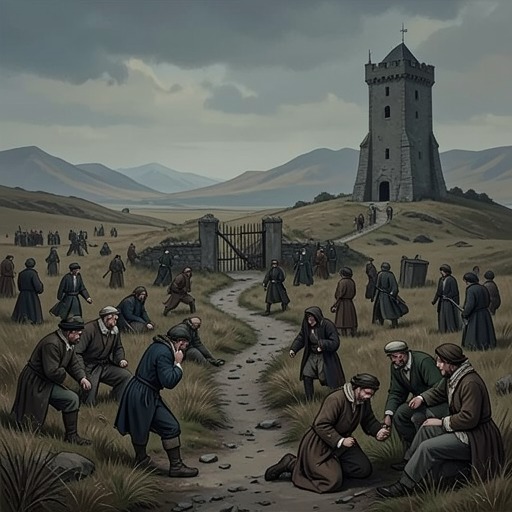
The same principle shapes encounters outside the crowded crisis. When young men approach the dancing dead, their hatred and terror grow stronger as they draw within a few metres. The dead stop dancing and turn toward them. One man calls out mockingly; another imagines a film zombie, and Flora understands that the group has come seeking a frightening spectacle. Their expectation of monstrous entertainment is accompanied by real fear and hostility, and the dead’s changed attention makes the encounter more dangerous. The scene places the spectators’ emotions inside the event rather than treating them as detached reactions to it.
Anna’s encounter with the creature that has killed her father gives the emotional connection a more intimate and sharply consequential form. She realizes that while she had sat on the bed doing nothing, the creature had simply watched from outside; after she went to the window and screamed at it to go away, sending it hatred and disgust, it broke the window. She understands her terror as one of the forces that drove its attempt to get inside. The realization does not make her responsible for her father’s death, but it changes how she understands the creature’s approach: her emotional response has entered the danger between them.
Her father also directs hatred toward the creature, imagining the eel-like shape in its chest. Anna tries to send a calming thought toward him, but cannot reach him in time. Later, with the creature approaching, she cannot simply think calmly; instead she concentrates on a song Elias’s voice has brought to mind. As she sings inwardly, the creature stops, its limbs going limp. It then turns back toward the inlet and her father’s body. Anna keeps her attention on the song rather than allowing grief and hatred to take over, sustaining her concentration until the creature has turned away. The episode suggests that emotional influence can alter the creature’s behavior, while also showing how precarious that influence is: Anna’s effort cannot undo the killing or reach her father, but it does interrupt the creature’s advance.
Consequences and Limits
Across these scenes, fear is neither merely private nor safely descriptive. It circulates among people, shapes their perception of the field, and can intensify the presence they fear. At The Heath, the loop becomes collective and nearly incapacitating; in the encounter with the young men, fear and hatred accompany the dead’s turn toward them; with Anna, terror is followed by a deliberate effort to hold attention on a soothing song, and the creature’s movement changes. These moments connect the field’s large-scale force to the small, immediate choices characters make under pressure.
The novel does not present emotional control as a general solution. Flora is overwhelmed by a field intensified by thousands, while Anna’s concentrated song affects one creature in a particular encounter and cannot save her father. The rule instead establishes a perilous reciprocity: people are not only subjected to the reliving field but may help strengthen it through the emotions passing among them. The returned dead and the living are caught in the same charged relation, in which fear can make a frightening presence larger, harder to bear, and more dangerous.